The BIL conference was a huge success! People came, saw, and learned! And HELPED! And heckled! And spoke, and listened, and shared! And they were FREE! ...
What utterly chaotic noise, what focus, what network, what beautiful minds and new friends!
I don't remember when I was last so engaged by so many brilliant input streams!
- savorie , on her experience at the BIL Conference
How do you organize an event that has that kind of effect on people? I don't think you can design it; it must be spontaneous, authentic, and emergent from the community. Just as the culture of a city like Austin or Boulder isn't created by a specific person, it emerges from everyone involved.
Part of BIL's success was that no one had any expectations of what was to come. We thought, "If 10 interesting people show up, that will be great!" When 300 from all walks of life showed up, it was unreal.
BIL2009 might have over 1000 people in attendance, and we're a bit worried about maintaining the culture and experience as this grows. There's both the organizational issues as well as the more fundamental participation issues (larger the group, more passive they become).
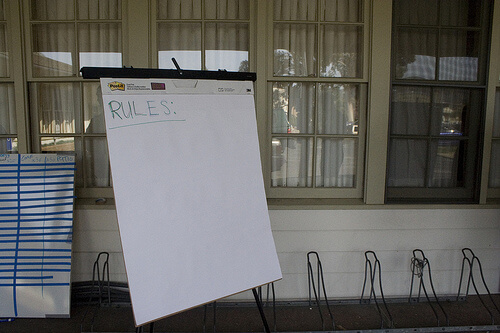
One thing we found was that certain aspects of an unconference don't scale well. The BIL schedule was organized BarCamp-style with a large whiteboard. Within 2 minutes, the schedule for both days was completely full. There were some great speakers who didn't get to share their ideas in the main room. The larger the group, the more of a problem this will become.
We also had some fun with wiki-based organization . The day of the conference, the wiki was changing so much that we had difficulty keeping the important information always accessible. While it's important that everyone can be involved, there needs to be some organization for everything to work out. Again, this becomes even more important as the grows.
I'd like to share with the community what we're planning to do to ensure this emergent, ephemeral experience can scale. I'd love it if you guys could share your thoughts on it.
- Voting for the main room. A month or two before the conference, we'll ask people to post what they'd like to discuss, and have a SXSW-style vote for the best talks. Clay Shirky suggested we have an "interestingness" rank based on views, comments, and votes. Once we sort them by interestingness, we might add and remove a few to make sure we have a diverse set of talks.
- Short talks and long talks. We'll have 15-20 minute talks in the main room, which holds about 1500 people. Right after the talk, the speaker can move to a smaller room (100-200 people) for a more indepth and personal talk for 30-60 minutes. Then the speaker and crowd can head down to the game room and common areas.
- Whiteboard for small rooms. We'll also have a bunch of smaller rooms that have Whiteboard schedules, like the original BIL.
We want to make sure anyone who wants to share an idea has somewhere to do it. We also believe that the smaller group discussions are much more valuable than the big, main room presentations. We'll have Revision3 filming all the main room talks, so you can always catch up on what you missed later.
Don't sit back and passively watch big talks in the main room. Watch these quick talks until something catches your interest, then follow that speaker and the ad-hoc group that forms around him for a great discussion. When you lose interest, break off and find another small group, or start your own talk.
So that's the current plan. What do you guys think of it? Any suggestions or ideas?
(By the way, BIL2009 will be in Long Beach, CA February 7-8. Get on the mailing list if you're interested.)
No comments yet